
You have probably seen both terms plastered across every activewear product page: compression and 4-way stretch. If you are building a daily Pilates habit, understanding each technology—and how they interact—can save you from wardrobe distractions that pull you out of your practice.
What Compression Actually Does During Pilates
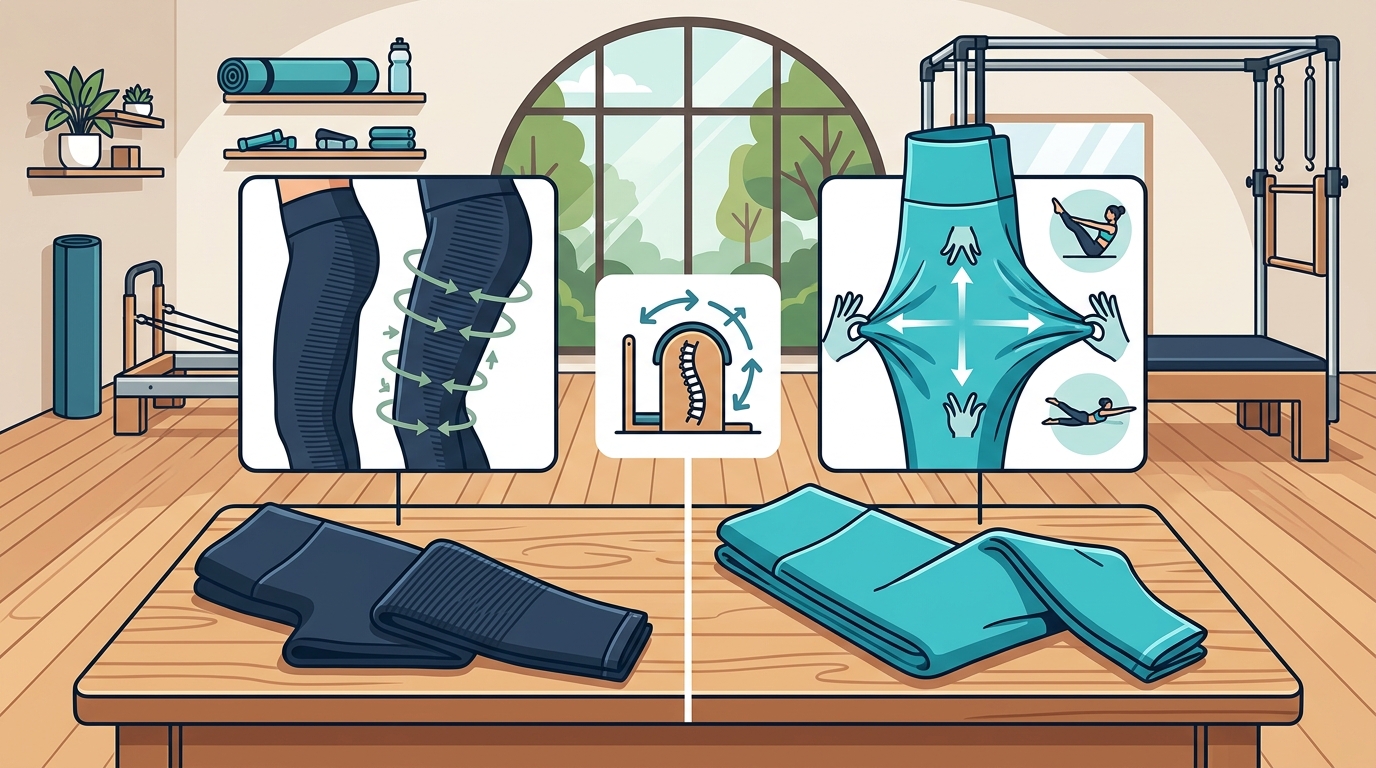
Compression leggings apply consistent, graduated pressure to the legs and core. This is not simply about tightness. Quality compression enhances blood flow and stabilises muscles during movement, which translates to reduced fatigue and a sculpted, secure feel. For Pilates specifically, that gentle pressure heightens proprioception—your internal sense of where your body is in space. When you can feel your muscles more clearly, you tend to engage them more deliberately during movements like pelvic curls or single-leg stretches.
Research backs up some of these claims. A 2014 study by Michael et al. found that greater balance was observed when wearing compression garments, which is directly relevant to the balance-heavy nature of Pilates. Additionally, a 2019 randomised controlled crossover study (Hettchen et al.) examined recovery parameters after exercise-induced muscle damage and found compression tights provided measurable benefits.
For daily practitioners, this means less residual soreness between sessions and a body-awareness advantage during precise, controlled movements.
What 4-Way Stretch Brings to Every Pose
Four-way stretch fabric moves with your body in all directions—horizontally, vertically, and diagonally—then recovers to its original shape. Standard two-way stretch only moves in one plane, meaning diagonal movements (think: spine twists, mermaid stretches, or open-leg rockers) cause the fabric to resist rather than cooperate.
This multi-directional flexibility is especially valuable for Pilates because the method demands constant transitions through different planes of movement. When your fabric fights back, you subconsciously limit your range of motion. Four-way stretch removes that invisible ceiling, allowing full expression of every exercise.
The technology typically relies on a blend of nylon or polyester with elastane (also marketed as Lycra or spandex). Higher elastane percentages—generally 12 percent or above—deliver more responsive recovery, keeping the leggings in place without constant readjustment.
Head-to-Head: Seven Criteria That Matter on the Mat
| Criteria | Compression Leggings | 4-Way Stretch Fabric |
|---|---|---|
| Range of Motion | Supportive but may feel restrictive during deep stretching if compression is too high | Unrestricted movement in all directions; ideal for exercises requiring full ROM |
| Muscle Support | Graduated pressure stabilises muscles and reduces vibration | Minimal compression unless combined with compressive construction |
| Body Awareness | Enhanced proprioception from consistent pressure against the skin | Lightweight, second-skin feel that some practitioners prefer for mindful movement |
| Recovery Between Sessions | Improved blood flow may reduce next-day soreness for daily practitioners | No inherent recovery benefit from stretch alone |
| Waistband Stability | Firm hold; less likely to roll during spinal flexion | Depends on waistband construction; stretch without compression can shift |
| Breathability | Tighter weave can trap more heat | Generally lighter weight and more breathable |
| Versatility | Excellent for reformer work and strength-adjacent Pilates | Works across mat Pilates, yoga, barre, and casual wear |
Mat vs Reformer: Does the Class Type Change the Answer?
Your class format should influence your fabric choice more than most people realise.
Reformer Pilates
On the reformer, you are working against spring resistance while sliding on a carriage. Snug compression leggings prevent fabric from catching on equipment or bunching around the knees during footwork sequences. The added muscle support also helps during resistance-based reformer exercises. One important note: avoid any leggings with zippers, snaps, or external hardware—these can snag on the reformer's upholstery or get caught in its moving parts.
Mat Pilates
Mat work involves more floor contact, rolling, and deep stretching. Here, 4-way stretch takes priority because you need full freedom through exercises like rolling like a ball, swan dive, and open-leg rocker. Seamless construction becomes especially valuable since bulky side seams can press uncomfortably into your skin during floor-based work. Many mat practitioners prefer a lighter, more breathable fabric with gentle compression rather than firm support.
The Daily Practitioner's Solution
If your daily routine alternates between mat and reformer—or includes both in a single session—look for leggings that combine medium compression with 4-way stretch. This hybrid approach gives you the muscle support of compression without sacrificing the movement freedom you need for floor work.
Fabric Blends and What the Numbers Mean
Understanding the composition label helps you predict how leggings will perform before you even try them on.
- Nylon-elastane blends (e.g., 80% nylon / 20% Lycra): Deliver a buttery-soft hand feel with excellent compression and shape retention. Nylon blends are known for that second-skin sensation that is extremely popular for Pilates. Look for 20 to 24 percent Lycra content for optimal compression without restriction.
- Polyester-spandex blends (e.g., 87% polyester / 13% spandex): Slightly more structured and moisture-wicking. These tend to dry faster and hold colour well over time, making them practical for daily use.
- Modal or bamboo blends: Softer and more breathable, but typically less compressive. Best suited for gentle mat sessions or studio-to-street versatility.
For yoga and Pilates specifically, nylon-elastane or modal blends tend to perform best because they are soft, flexible, and allow full range of motion without skin irritation.
Durability for a Daily Practice
When you are practising Pilates every single day, your leggings face roughly 365 wash cycles per year. This is where fabric quality becomes a financial decision, not just a comfort one.
Premium Lycra maintains its elasticity through 500-plus washes, while lower-grade spandex can lose its stretch after as few as 30 to 50 wears. That means a high-quality pair of leggings with technical fabric can last well over a year of daily use, while budget options may need replacing every month or two.
Practical tips for extending legging life when practising daily:
- Rotate three to five pairs so each pair gets a rest day between washes
- Wash inside out in cold water to protect the outer face of the fabric
- Skip the dryer—heat breaks down elastane fibres faster than anything else
- Avoid fabric softener, which coats moisture-wicking fibres and reduces their performance
Key Takeaways
- Compression and 4-way stretch are not opposing choices. The best daily Pilates leggings combine both technologies in a single garment.
- Medium compression (not high) is the sweet spot for daily Pilates. It provides muscle support and body awareness without restricting deep stretches or breathing.
- Reformer practitioners should lean toward more compression; mat practitioners should prioritise stretch and seamless construction.
- Fabric composition matters. Aim for at least 12 percent elastane content for reliable 4-way stretch, and choose nylon blends for softness or polyester blends for durability.
- Invest in quality for daily use. Technical fabrics that maintain compression through 500-plus washes are more cost-effective per wear than budget options that lose shape in weeks.
Frequently Asked Questions
Are compression leggings good for Pilates?
Yes. Gentle, supportive compression enhances body awareness, helping you feel more connected to your core and muscles during precise movements. It can also improve balance and reduce fatigue during longer sessions. However, avoid excessively tight compression that restricts deep stretching or breathing.
What is 4-way stretch and why does it matter for Pilates?
Four-way stretch fabric stretches horizontally, vertically, and diagonally, then returns to its original shape. This matters because Pilates involves constant multi-directional movement. Two-way stretch fabric fights against diagonal movements like spine twists, which can subtly limit your range of motion.
Can I wear the same leggings for mat and reformer Pilates?
Yes, if you choose leggings with medium compression and 4-way stretch. This combination offers enough support for reformer resistance work while remaining flexible enough for mat-based floor exercises. Just ensure your leggings have no external hardware that could catch on reformer equipment.
What fabric blend is best for daily Pilates leggings?
For daily practice, a nylon-elastane blend with 15 to 24 percent elastane content offers the best balance of softness, compression, and durability. Polyester-spandex blends are a strong alternative if moisture-wicking and quick drying are priorities.
How many pairs of leggings do I need for daily Pilates?
Most regular practitioners find three to five pairs ideal, allowing rotation between washes. This extends the life of each pair and ensures you always have a clean, performance-ready option.
Do compression leggings help with recovery between daily sessions?
Compression garments can enhance blood flow to the legs, which may support recovery between sessions. Studies have shown benefits for reducing exercise-induced muscle damage markers. For daily practitioners, this recovery support can make a meaningful difference in how your legs feel from one session to the next.